
When Preservation Becomes Taxidermy
Le Corbusier’s Cité Radieuse is a “dream that has turned into a nightmare.” During the 2026 heatwave, some apartments recorded indoor temperatures above 30 degrees. An interview published in Le Progrès shows residents angered by the heat, considering moving if no measures are taken.
The same issue can be observed with Parisian zinc roofs. This material absorbs a large amount of heat and can contribute to overheating in attics and top floors during periods of extreme heat. Yet some experiments show that green roofs or improved insulation can significantly reduce temperatures beneath the roof. However, their installation is not permitted on all buildings, particularly when they are protected as heritage or located within heritage zones, where the preservation of their historical appearance takes precedence over certain transformations.
“When it is 40°C in the shade in Paris, zinc surfaces can reach 70°C, 80°C, or even 85°C.”
In France, there is no strict minimum age for a building to be protected as heritage. In Switzerland, regulations vary by canton, but in several of them a building is generally expected to be around thirty years old before it can be considered for protection. In both countries, however, age alone is not sufficient: a building must also have historical, architectural, artistic, or cultural significance.
This shows that a building can be protected relatively early in its life, sometimes within its first decades of existence.
Heritage protection, however, comes with its own set of constraints. Once a building is listed, making changes to it becomes considerably more complicated. Exactly what is permitted depends on the country, the local authorities, and the level of protection the building has received, so there is no universal rulebook. But one thing remains true almost everywhere: even modest interventions usually involve long administrative procedures and approval from several different authorities.
Since the 1990s in particular, researchers have questioned the future of historic buildings, and more recently—over the past decade—their adaptation to climate change.
“Building on the Athens Charter, the Venice Charter helped establish normative modes of conservation and restoration such that important buildings would be preserved authentically based on primary source evidence. In many ways, the effect of such restoration is akin to taxidermy in which the subject is frozen in time—the mount poised for action, the building fixed to a particular date, neither to age again.”
The aim of heritage regulations is to preserve architectural works considered irreplaceable. Historic buildings are valued not only for their architecture but also as material evidence of a particular time, its construction techniques, and its understanding of the city. Many Western countries consider them to be more than private property. They are seen as part of a shared cultural legacy, one that helps shape collective memory and cultural identity.
In the case of the Cité Radieuse, the project was conceived as a total work of art (Gesamtkunstwerk), as the materials, proportions, construction details, and relationship with the environment constitute the integrity of the work designed by Le Corbusier. Any modification would then be considered to alter the building. Similarly, zinc roofs are not only the roofs of most Parisian buildings; they collectively compose the urban landscape and contribute to the city's identity.
However, this desire to preserve authenticity comes into tension with new challenges, more recently those linked to energy transition and climate change. The question is no longer only how to preserve buildings, but also how to allow them to adapt so that they remain habitable, efficient, and resilient. It is precisely in this search for balance that difficulties arise.
A comparative study by Dóra Mérai, Loes Veldpaus, John Pendlebury, and Markus Kip across fifteen European countries shows that obstacles to heritage adaptation do not stem solely from the strictness of regulations. They also result from the complexity of governance systems. Responsibilities are often distributed across multiple administrative levels—state, regional, and local authorities—and across different policy domains, such as heritage, urban planning, or environmental regulation. This fragmentation makes procedures lengthy and sometimes contradictory, as different actors do not always pursue the same objectives.
The authors identify several European models. In countries such as England, the Netherlands, and Sweden, regulatory frameworks allow more room for negotiation between authorities and project developers. This flexibility facilitates building adaptation while still maintaining control over interventions to preserve heritage value. By contrast, other countries are characterized by a stronger separation between heritage protection policies and urban planning policies. Procedures there become more complex, responsibilities are distributed across multiple institutions, and projects often require successive approvals at different administrative levels.
This recent heatwave inspired the theme of this article and made me question our relationship to heritage. It reminded me of a course on urban history I took during my exchange in Rome. One day, the professor shared his opinion on the disruptions caused by archaeological discoveries during the construction of Rome’s new metro line in the city center. His reflection surprised me coming from an historian: for a city to continue functioning and remain livable, it must sometimes accept the transformation and loss of a portion of its heritage in order to make room for new development.
This remark, said more than five years ago, has stayed with me ever since. How can we reconcile the preservation of heritage that bears witness to our history with the need to adapt cities to contemporary demands? What are we willing to give up in order to respond to present needs, whether related to climate change or evolving ways of living? And conversely, what do we choose to preserve, and why?
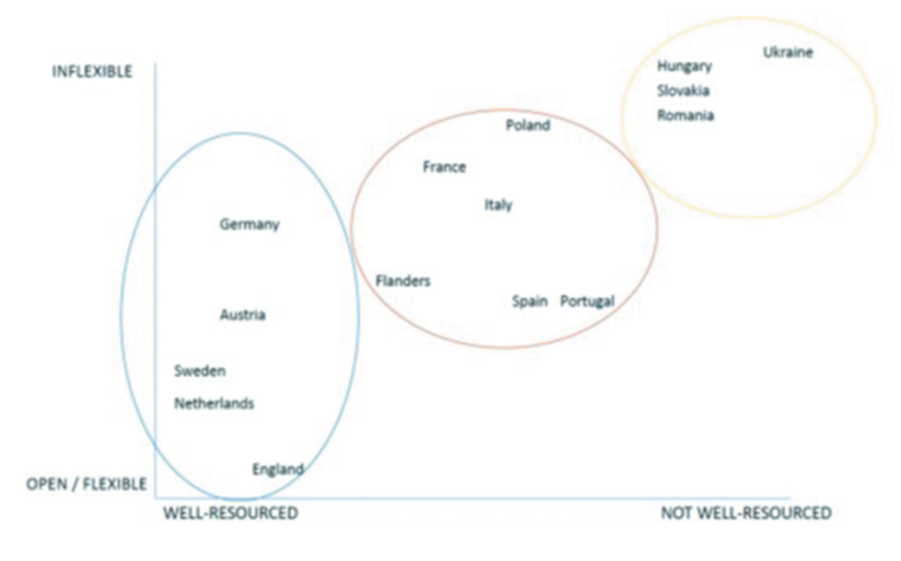
Notes on the graph:
Group 1 (Germany, Austria,Sweden,Netherlands,England):
“[...] This creates a space where change and significance can be negotiated, more easily allowing a tailored approach to adaptive reuse cases. This generally facilitates reuse, but can create risk; for example, decision-makers can decide to say no to reuse, or to say yes to harmful proposals. While heritage regulations can be strict, policy and funding are often focused on bringing buildings back into use, with the option to negotiate material change. [...] The three countries that fell most clearly in this group are England, the Netherlands and Sweden, as their conservation-planning assemblages are most clearly supportive of adaptive heritage reuse, sometimes by directly developing policy to support the practice.”
Group 2 (Poland, France, Italy, Flanders, Spain, Portugal):
“[...] In common with the countries in group 1, some countries have strong, well-resourced, heritage regulatory systems. However, adaptive reuse practices are more. difficult because of an inflexible heritage protection framework in combination with a lack of integration across planning and heritage systems. This creates complexities and contradictions that set obstacles for projects, and especially for civic initiatives. In several cases,formal responsibilities for heritage and planning are situated on different levels of government, and these levels aren’t always clear on who has responsibility for what.A frequent issue is that responsibilities for nationally protected heritage lie at a regional or national level, whereas spatial planning and regulation happen at a local level. This combined with a lack of institutional capacity and funding can lead to long procedural times (e.g., when all local applications need regional approval) and complex procedures. [...] Overall, adaptive heritage reuse in this category is typically complex, making bottom-up projects more challenging, with difficult to navigate and opaque institutional arrange-ments, especially for those without experience, time, capacity, or resources.”
Bibliography:
Foster, Gillian, and Ruba Saleh. 2021. "The Adaptive Reuse of Cultural Heritage in European Circular City Plans: A Systematic Review" Sustainability 13, no. 5: 2889. https://doi.org/10.3390/su13052889
Neveu, Marc J. 2018. “Taxidermy or Translation?” Journal of Architectural Education 72 (2): 185. doi:10.1080/10464883.2018.1496712.
Prados, Justine. 2024. “À Paris, la végétalisation d’un toit fait baisser la température intérieure jusqu’à 17°C en plein été”. Vert.
Garapon, A. et Arthur Collot. Juin 2026. “Vivre dans un monument classé en pleine canicule : l'enfer des habitants du Corbusier à Firminy.”Le Progrès.
