
The idea that women’s rights have continuously progressed over the centuries remains widespread, with each successive era supposedly bringing greater freedoms and equality. Yet this view is far from reflecting historical reality. In her book Les Grandes Oubliées: Pourquoi l’Histoire a effacé les femmes (The Great Forgotten Women: Why History Has Erased Women), Titiou Lecoq shows that women’s rights in France have experienced successive setbacks and transformations. Throughout history, women have enjoyed different forms of rights, autonomy and recognition.
One of the major turning points in this regression came under the rule of Napoleon Bonaparte, with the adoption of the Civil Code in 1804. It institutionalised and reinforced a patriarchal social order, placing married women under the authority of their husbands and severely restricting their autonomy.
Throughout its chapters, the book examines the position of women in French society, from prehistory to the present day. In the chapter devoted to the Middle Ages, the author explores, among other things, women’s role in the construction of cathedrals. As architects, craftswomen and labourers, women were far more present in the construction industry than they would be in the twentieth century.
What we learn from this sixth chapter is that, during this period, women had greater access to public spaces and a wider range of occupations than in the industrial era. Although labour was divided along gender lines — with women particularly numerous in the textile industry — they were present in many different trades, often as part of a family workshop. “Among craftspeople, men and women worked together; wives appeared in contracts and, upon becoming widows, could continue running the business.” Women also worked on construction sites: archival records reveal that they took part in digging the foundations of Notre-Dame Cathedral, making mortar, carrying stones and building scaffolding. They also worked as goldsmiths, stonemasons, painters and in other skilled trades.
Even more surprising is the degree of autonomy enjoyed by nuns in the design and construction of their convents, where they could serve as architects, entrepreneurs and project managers. Although their role as builders has been recognised in academic literature since the 1990s, it remains largely unknown to the general public. The research of Julie Piront, a historian specialising in female convent architecture, shows that nuns working as architects were not isolated exceptions, but relatively common figures. Unlike monks, however, nuns generally undertook construction projects only for their own monasteries, due to the strict enclosure imposed on female religious communities. One notable exception was the Visitandine nun Madeleine-Élisabeth de Chaumont (c. 1627–1707), who built three convents over a period of twenty years.
Several scholars [...] have demonstrated the remarkable diversity of artistic practices within women's convents [...], bringing to light the previously anonymous work of nuns who were painters, miniaturists, gilders, embroiderers, goldsmiths, draughtswomen, lacemakers, composers and musicians, as well as architects, construction project managers and even manual labourers. (Piront, 2018)
In her research, Piront also investigates how these nuns acquired their architectural knowledge. Due to the lack of surviving sources, it is difficult to provide a definitive answer. She suggests, however, that their training relied largely on the reading of theoretical treatises and architectural manuals. Some nuns also had the opportunity to visit other convents and draw inspiration from them. Finally, some women architects appear to have received training before entering religious life, particularly within their own families.
In the Middle Ages, women in France enjoyed a surprising degree of freedom in their use of public space and were active in far more trades than one might expect. They were nevertheless excluded from universities, which were reserved for clerics, who categorically barred women from admission. This exclusion had lasting consequences. From the fourteenth and fifteenth centuries onwards, the rise of this educated male class increasingly contributed to restricting women's place in society. Regulations governing women became progressively stricter, while their work lost recognition and they appeared less and less frequently in historical records.
This marked the beginning of a process of increasing precariousness and proletarianisation of women's labour, which continues to this day. (Lecoq, 2021)
Recognition of women's contributions to medieval construction remains largely confined to specialised academic research and is still largely absent from broader accounts of architectural history. Yet their roles on building sites and in the design of buildings constitute an important field of research, one that broadens our understanding of the people involved in medieval architectural production.
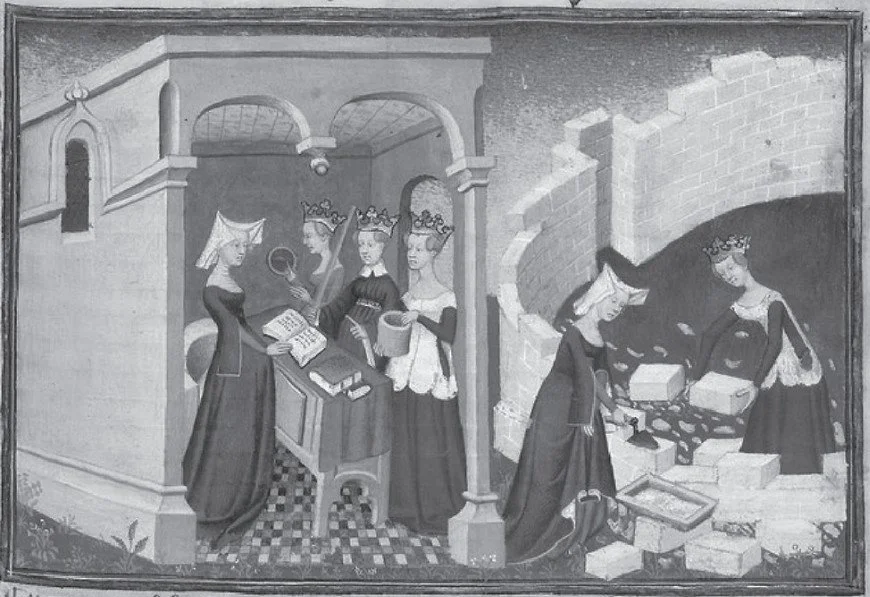
Master of the Cité des Dames, Women Building the Walls of the City of Ladies, 1400–1410, detail from Christine de Pizan, The Book of the City of Ladies, fifteenth century. Bibliothèque nationale de France, Department of Manuscripts, Français 607, fol. 2r. © Photograph: BnF, Department of Manuscripts.
This text was translated with the use of AI
Sources:
Lecoq, Titiou. Les grandes oubliées: Pourquoi l'Histoire a effacé les femmes. Paris: L'Iconoclaste, 2021.
J. Piront. "Les religieuses à l’époque moderne : architectes, gestionnaires de chantier et manouvrières." Livraisons d'Histoire de l'Architecture, 35 (2018): 29-39.
Les monuments nationaux. “Femmes bâtisseuses.” https://www.monuments-nationaux.fr/magazine/dossiers-thematiques/grands-personnages/femmes-batisseuses
