
Can we speak of “feminine” architecture?
A reflexion on architecture designed by women
In January, I finished an article on the Belgian architect Simone Guillissen-Hoa. However, for several months I have not managed to publish it. One question holds me back: what am I really trying to convey through this blog, on which I publish approximately once every three months? Is my goal simply to offer a summary of the texts I have read on this or that architect, with the intention to introduce you to a new architect that you might not have the time to read about?
This hesitation leads me to a broader question. Why did I choose to write about these female architects? Is it only to highlight the work of women architects whose work remains largely unknown, or do I feel that their way of thinking about architecture allows certain questions to be examined more broadly?
This question leads to another: can we identify, in the work of female architects, a specific way of approaching space or architectural practice? In other words, are there recurring themes in the way they conceive projects, organise spaces or think about the relationship between architecture and how they are used?
Before even attempting to explain the origin of such a difference, be it social, historical or cultural, I first wonder whether this difference actually exists and can be quantified. Can we observe, across several architects, project approaches that differ from those of men, who largely dominate the discipline?
Similar questions have been raised in other artistic fields. In literature, for example, Virginia Woolf was already questioning, at the end of the 19th century, the social conditions that shaped women’s writing. In cinema, Laura Mulvey’s analyses have highlighted how the director’s gaze, which structures the images, can be linked to the position of the person producing them.
But what about architecture, a field in which space constitutes the primary medium? Does the way space is conceived differ when made by women? And to what extent is this architecture free from the dominant male perspective that has shaped our architectural references?
I reflected on this question whilst reading what Hélène Cixous had to say about ‘feminine writing’. In The Laugh of the Medusa, Cixous urges women to write outside the traditional rules of patriarchy. In this text, Cixous “commands women to use writing and the body as sources of power and inspiration”.
Transposed to the field of architecture, this reflection raises an even more delicate question: can architecture, a discipline deeply structured by formal, technical and theoretical conventions, truly free itself from its aesthetic and spatial canons simply because the designer of these spaces is a woman?
These questions have been on my mind for some time. But it was whilst reading the monograph on Simone Guillissen-Hoa, written by Caroline Mierop, that these questions resurfaced. In this monograph, I discovered an architect whose work is distinguished by its lack of monumentality. Her projects instead reflect a discreet modernism, attentive to the user. Guillissen-Hoa designs dwellings rather than villas, whose plastic and spatial qualities produce spaces capable of standing the test of time.
Although she belongs to the second wave of modernism, Guillissen-Hoa does not confine herself to the movement’s dogmas. She does not merely use flat roofs for the sole purpose of creating sculptural volumes, but prioritises designing for the quality of circulation and comfort for the inhabitants. And as I read this, I realised that these aspects differed markedly from the male historical figures I had encountered in my architectural history lectures.
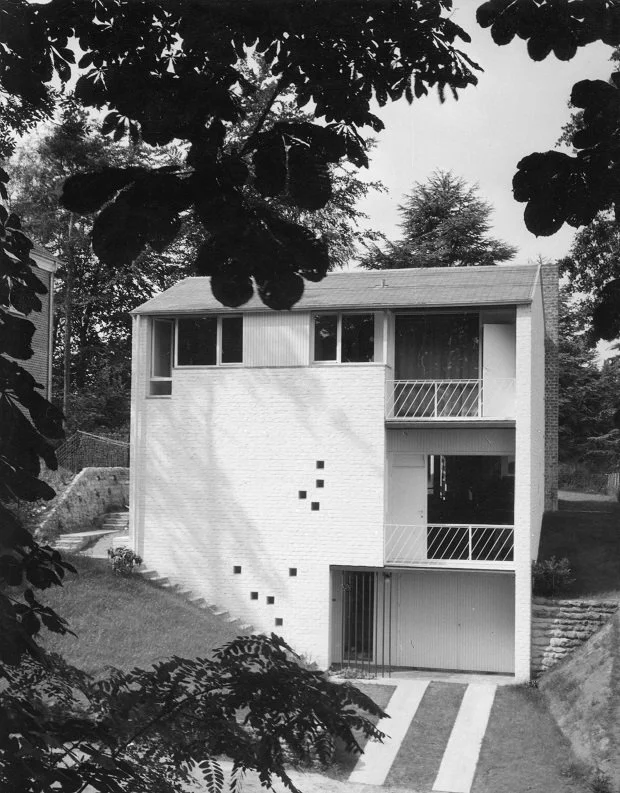
But is there such a thing as a feminine perspective on architectural construction—not feminist architecture, but feminine architecture? Is the way of thinking about and constructing space different? Can a female architect truly break free from architectural conventions, based on a theory of architecture almost entirely developed by Western men? To borrow the words of Hélène Cixous, who theorised the concept of feminine writing, can we conceive of an architecture that “attempts to break free from the conventional rules of patriarchal systems”?
The original text (in French) has been translated with the help of AI.
