
Ilse Frank: what do we know about the woman who shaped the Bauhaus ?
Alternative title: Please research on Ise Gropius Ilse Frank.

Frank, Ilse, “Self-Portrait in the bathroom mirror”, 1926.
This picture symbolically represents all the roles endorsed by Ilse Frank* at the Bauhaus.In this self-portrait, her profile is reflected in the mirror nine times. Frank's multifaceted contributions at the Bauhaus encompassed roles such as ghostwriting, research, promotion, chronicling, proofreading, curation and secretarial duties. However, she remains relatively unknown, despite the fact that the institution she dedicated her life to promoting is well-known to the general public.
What do we know about Ilse Frank and why so few of us know her name and her work?
The present post has been inspired by Cooking Up Dinner Speeches. Ise Gropius in Japan, a publication by gta Verlag edited by Almut Grunewald. It is the sole substantial contribution since Mercedes Valdivieso’s research of 2019 titled “Ise Gropius: Everyone here Calls Me Frau Bauhaus”. In fact the goal of the book is stated to be to “animate the reader and researchers to discover more of Ise Gropius,” underscoring the dearth of research on this Bauhaus figure.
Cooking Up Dinner Speeches is composed of an introduction of Ilse Frank by Grunewald, followed by a collection of letters written during Gropius and Frank’s travel to Japan in 1954. It is through these series of correspondences, written in English with the intention of being made public, that we gain insight into the witty personality of Frank and the various roles she undertook to promote her husband's work and ideas.
Frank was born in 1897 into a middle-class liberal family. She was encouraged by her father to pursue university studies but began her professional career in a Munich publishing house in 1921. She became proficient in English thanks to a study exchange in England. However, after meeting Walter Gropius in 1923, she soon abandoned her independent professional path to support the man who would become her husband later that year. Although she continued throughout her life to promote and archive his work, she later regretted not having sought greater recognition for her own contributions and not having published her independent writings.
Ilse Frank can be described as the brain behind the Bauhaus’s administrative and organisational decisions. Among other things, she oversaw the new fundings which led the Bauhaus from Weimar to Dessau, developed a network of architects by hosting dinners, proposed the creation of the “Masters’ Houses” in Dessau to foster a closer exchange between students and teachers. She also contributed to the Bauhaus’s international visibility by writing several publications and by curating the 1928 MoMA exhibition.
Her contribution extended far beyond the institution itself. Frank acted as the ghost-writer for Gropius’s speeches, articles, and even his personal correspondence, while also meticulously recording his impressions during their travels. Her attentive architectural eye emerges not only in her letters but also in her concrete interventions at the Gropiuses’ Masters’ House. In addition to supporting Gropius with administrative tasks, she was responsible for the domestic work, which led her to design the kitchen of their home as a functional and modern space. She developed this kitchen shortly before Margarete Schütte-Lihotzky’s famous Frankfurt Kitchen.

Attempting to exhaustively list all her contributions would require a PhD research as her contributions were rarely mentioned. This article instead seeks to emphasise the extent to which Frank played a decisive role in the success and public image of the Bauhaus. Further research on the specific forms of her involvement can be found in the bibliography.
The podcast Bauhaus’ Faces by Anja Guttenberger is another valuable resource on Ilse Frank’s contribution to the Bauhaus. Guttenberger, who has long worked on Bauhaus-related topics at the Bauhaus-Archiv and the Stiftung Bauhaus. The episode dedicated to Ilse Frank can almost be read as a research paper in itself. In it, Guttenberger interviews Jana Revedin, author of the fictionalised biography Jeder hier nennt mich Frau Bauhaus. Das Leben der Ise Frank. Revedin, architect and writer, had been commissioned by the publisher Dumont to bring forward a lesser-known Bauhaus figure. She chose fiction as a way to approach Frank for a more intimate and personal angle. However, I was somewhat disappointed by the novel which focuses mainly on Ilse Frank’s early relationship with Gropius and her move from Munich to Weimar, offering only a partial glimpse of her role in the Bauhaus’s success and of her extensive writing activity.
Frank left numerous archival documents, ranging from letters to friends to her personal diary. Some of these texts were later rewritten and corrected by her, suggesting that she intended them to be published. Unfortunately her Bauhaus-period diary, which spans about 230 pages including letters, has not yet been published by the Bauhaus-Archiv. Almut Grunewald’s publication demonstrates how this material can be made accessible to the public by contextualising Frank’s writings with concise annotations. This contribution represents an important step toward deepening our understanding of her role within the Bauhaus and her intellectual legacy.
* In 1923 Ilse Frank married Walter Gropius, changing her name to Ilse Gropius. In 1935 he legally changed her name to Ise Gropius. Throughout this article I will refer to her with her original name, Ilse Frank.
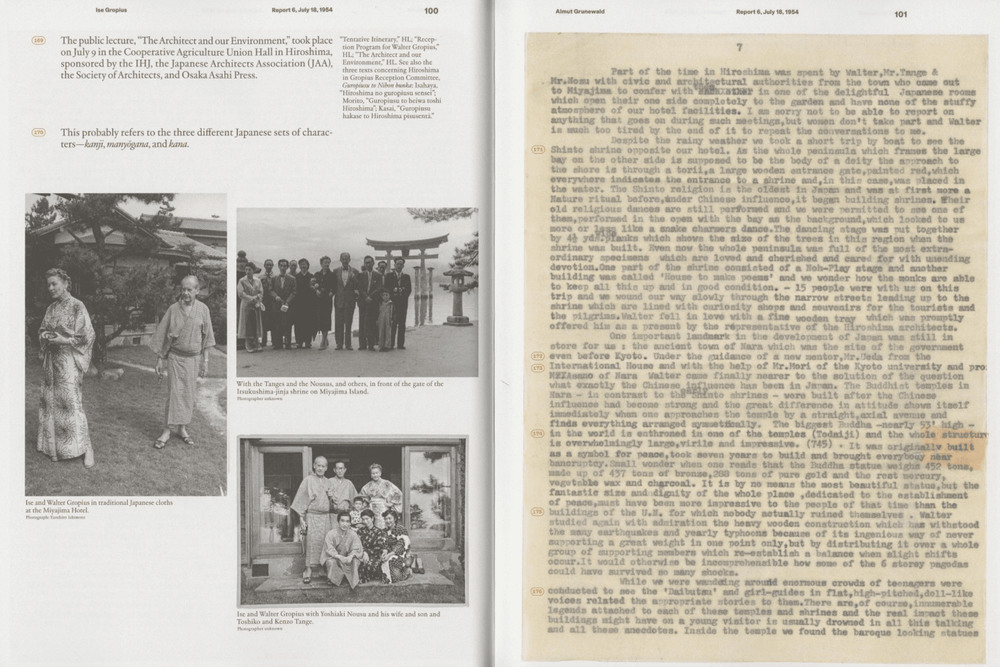
Cooking Up Dinner Speeches. Ise Gropius in Japan, edited by Almut Grunewald, gta Verlag.
Tour of the Gropiuses’ House: https://gropius.house/location/video-tour-by-ise-gropius/
Bibliography:
Frank, Ise. 1978. "Friend of the Busch-Reisinger and Fogg Museum."
Guttenberger, Anja. 2024.12.6 “Ise Gropius. Jana Revedin” 42 min.
https://www.bauhausfaces.com/start/episode/d1238141/ise-gropius-or-jana-revedin
Grunewald, Almut. 2025. Cooking Up Dinner Speeches. Ise Gropius in Japan. gta Verlag.
Kelleher, Katy. 2018. "The Forgotten Story of "Mrs.Bauhaus". Artsy.
https://www.artsy.net/article/artsy-editorial-forgotten-story-mrs-bauhaus.
Pansera, Anty. 2022. 494 : Bauhaus Al Femminile : 475 Studentesse, 11 Docenti, 6 Donne Intorno a Gropius, 1 Manager, 1 Fotografa. Busto Arsizio: Nomos Edizioni.
Valdivieso, Mercedes. 2019. "Ise Gropius: "Everyone here Calls Me Frau Bauhaus".
